Caching
Set cache_dir on the Pipeline and every step with a BaseModel result is cached there.
A step runs again only when its cache key changes.
What is in the key
- The step class name, or its
kindif it has one. - The source code of the step class body.
- Every dataclass field, except
Configfields. - The cache keys of upstream steps,
InputParamvalues, andFileSourcefile content.
So a change to any of these recomputes that step and everything downstream. Nothing else recomputes.
flowchart LR
    cls["Class name or kind"] --> key
    body["Class body source"] --> key
    fields["Fields, except Config"] --> key
    up["Upstream cache keys"] --> key
    inputs["InputParam values"] --> key
    files["FileSource content"] --> key
    key(["Cache key: 12 hex characters"]) --> saved{"Result saved under this key?"}
    saved -- yes --> load["Load it. The step does not run."]
    saved -- no --> run["Run the step. Save the result under the key."]
Example: a pipeline with four steps ran once. Then Clean.case changed. Clean and its
downstream step Report are pending (yellow). Load and Count stay cached (green).
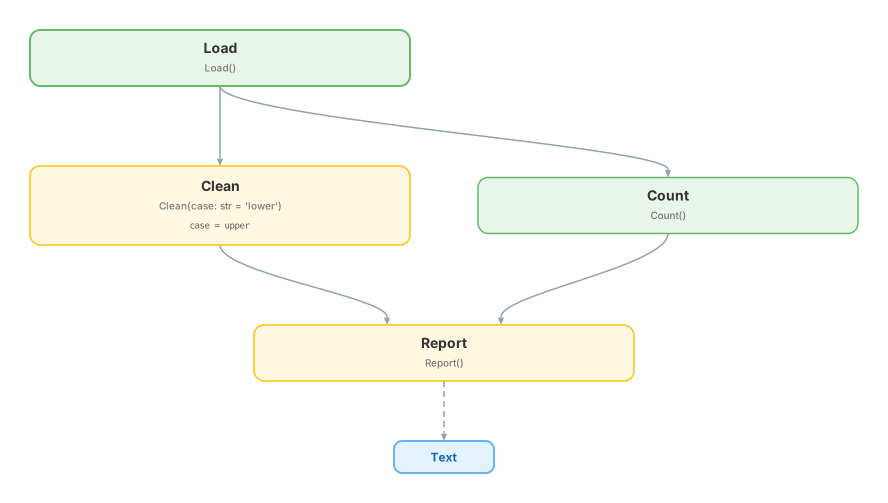
The image comes from dag(...) on docs/examples/graph_states.py.
Keep a field out of the key: Config
Wrap execution-only settings (worker counts, clients, timeouts) in Config. run() receives
the plain value.
"""Caching: what is in the key, and what Config leaves out."""

import tempfile
from dataclasses import dataclass
from pathlib import Path

from pydantic import BaseModel

from adag import Config, NullObserver, Pipeline, Step

RUNS: list[int] = []


class Total(BaseModel):
    value: int


@dataclass(frozen=True)
class Scale(Step[Total]):
    factor: int  # in the cache key
    workers: Config[int] = Config(4)  # not in the cache key

    def run(self, factor: int, workers: int) -> Total:
        RUNS.append(factor)
        return Total(value=10 * factor)


cache = Path(tempfile.mkdtemp())
for step in [
    Scale(factor=2),
    Scale(factor=2),
    Scale(factor=2, workers=Config(16)),
    Scale(factor=3),
]:
    before = len(RUNS)
    Pipeline(step(), cache_dir=cache).execute(observer=NullObserver())
    print(f"{step!r:45} ran: {len(RUNS) > before}")
Scale(factor=2, workers=Config(4))            ran: True
Scale(factor=2, workers=Config(4))            ran: False
Scale(factor=2, workers=Config(16))           ran: False
Scale(factor=3, workers=Config(4))            ran: True
Supported field types
Fields are hashed by adag.hashing.encode_value: None, bool, int, float, str,
bytes, Enum, Path, UUID, type, BaseModel, and list, tuple, dict, set of
those. A field of another type raises UnhashableValueError: wrap it in Config, or set
strict_content_hash = False on the class to skip such fields.
A Path field is hashed by its text. To hash a file's content, pass a FileSource.
Limits
- Only the step's own class body is hashed. An edit to a base class or to a helper function
the step calls does not change the key. Change a field or the
kindversion when it should. - Any edit inside the class body changes the key, comments included.
- A step whose result is not a
BaseModelis not cached, unless it overridessave_resultandload_result(see below). - Keys are 12 hex characters (48 bits) of SHA-256.
Why did a node recompute
Call node.explain_key(params): it lists every component of the key with a digest. See
Why a step recomputed.
On disk
adag writes three entries per result, in this order:
<cache_dir>/<key>: the result as JSON.<cache_dir>/<key>.done: the marker. A result without it is a miss.<cache_dir>/.keys/<key>.json: the key record (see Why a step recomputed).
An empty result file, or one that does not parse, is also a miss: the step runs again.
With store=, the same three keys go to the store (see Cache stores).
Results that are not one JSON document
Override save_result(result, path) and load_result(path) to cache a result in your own
format: JSONL, a custom file, a file plus a sidecar, or a directory.
pathis<cache_dir>/<key>, where the key covers the step, its inputs and the run params.save_resultcreatespathas a file or a directory. adag passes a temporary path and renames it into place, then writes<key>.done.load_resultreads it back. Raise any exception to mark the entry invalid: the step runs again.- Downstream steps always get the value
load_resultreturns. On the first run too: adag saves the result, then hands onload_result(path), not the valuerunreturned. - So
load_resultmust rebuild everythingrunput in the result. A pydantic field markedexclude=Trueis lost unlesssave_resultwrites it to its own file. - When the reloaded value differs from the one
runreturned, adag logsstep.load_result_differs, once per step class. node.is_cached(cache_dir, params)callsload_resulttoo, so it costs one load.- Override both methods, or neither. Overriding one raises
TypeErrorwhen the class is defined. - These results live under
cache_dir. A run withstore=and nocache_dirraises before the step runs.BatchStepuses the same two methods for its assembled result.
"""Cache a result that is not one JSON document: JSONL here."""

import json
import tempfile
from dataclasses import dataclass
from pathlib import Path

from adag import InputParam, Pipeline, Step


@dataclass(frozen=True)
class Records(Step[list[dict[str, int]]]):
    def run(self, n: int) -> list[dict[str, int]]:
        print("computing records")
        return [{"i": i} for i in range(n)]

    def save_result(self, result: list[dict[str, int]], path: Path) -> None:
        path.write_text("".join(json.dumps(r) + "\n" for r in result))

    def load_result(self, path: Path) -> list[dict[str, int]]:
        return [json.loads(line) for line in path.read_text().splitlines()]


with tempfile.TemporaryDirectory() as cache:
    pipeline = Pipeline(Records()(n=InputParam[int]("n")), cache_dir=Path(cache))
    print(pipeline.execute(n=3))
    print(pipeline.execute(n=3))
(output trimmed: log lines removed)
To port a deprecated CachedStep override: rename save(self, result, cache_dir) to
save_result(self, result, path) and write to path instead of self.output_path(cache_dir).
Rename load to load_result(self, path), and move the checks of validate into
load_result as exceptions. Each result is computed once more, under its new key.